Vishnu Sahasranama — Meaning, Benefits & How to Recite It Daily
What the Vishnu Sahasranama is, where it comes from in the Mahabharata, how its 1,000 names are structured, what the phalashruti promises, and a realistic routine for reciting it daily even if you cannot read Sanskrit.
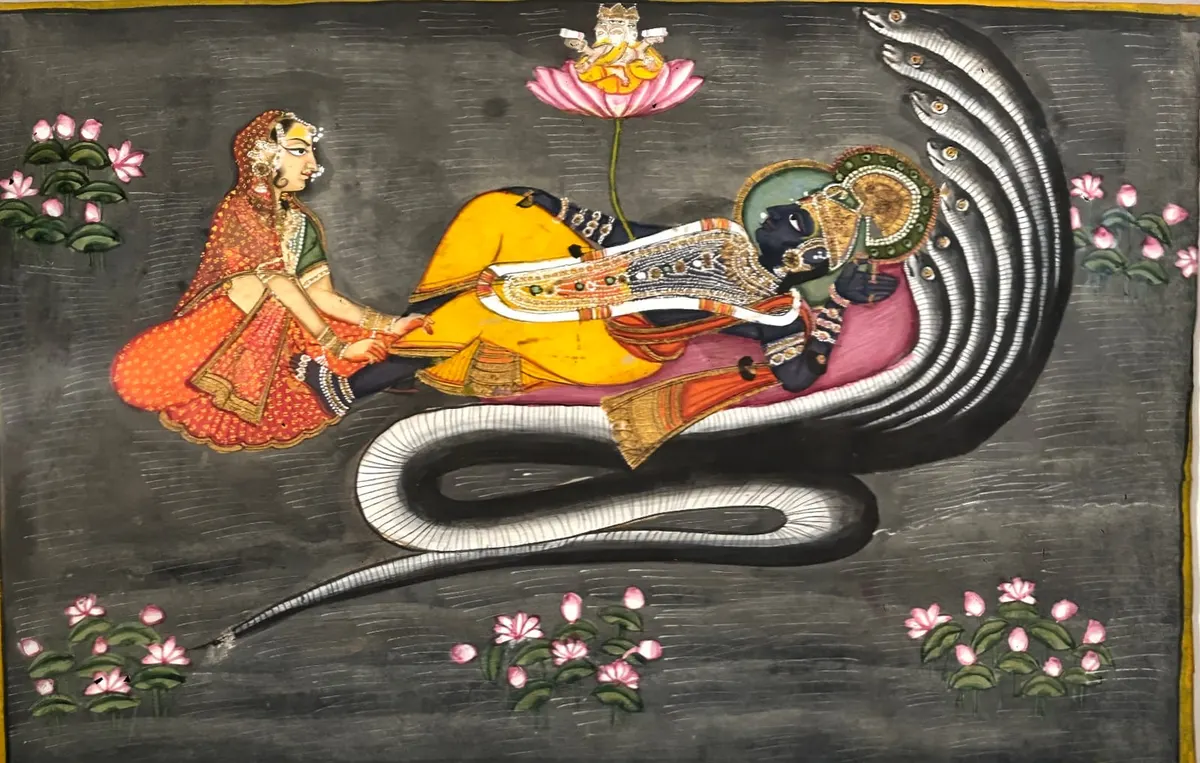
The Vishnu Sahasranama is a hymn of one thousand names of Vishnu. It is one of the most widely recited texts in Hinduism — chanted in temples at dawn, played in homes during the morning routine, and memorised by people who never learned Sanskrit grammar. Unlike a short mantra, it takes real effort to learn, which is why a clear plan helps. This guide explains what the text is, how it is built, what it means, and how to make it part of an ordinary day.
Where the Vishnu Sahasranama Comes From
The hymn appears in the Anushasana Parva of the Mahabharata, the book of “instruction” that follows the great war. Bhishma, grandsire of both the Pandavas and the Kauravas, lies on a bed of arrows waiting for the auspicious moment to leave his body. Krishna brings Yudhishthira to him so that the new king can receive his wisdom before it is lost.
Yudhishthira, weary from the war and burdened by kingship, asks Bhishma six questions in two verses:
किमेकं दैवतं लोके किं वाप्येकं परायणम् । स्तुवन्तः कं कमर्चन्तः प्राप्नुयुर्मानवाः शुभम् ॥ को धर्मः सर्वधर्माणां भवतः परमो मतः । किं जपन्मुच्यते जन्तुर्जन्मसंसारबन्धनात् ॥
“Who is the one deity in the world? What is the one supreme refuge? Praising whom, and worshipping whom, do human beings attain good? Which dharma do you consider the highest of all dharmas? By repeating what is a being freed from the bondage of birth and samsara?”
Bhishma answers that the one refuge is the Lord of the universe, the infinite Purushottama, and that the highest of all dharmas is to praise Him constantly with His thousand names and worship Him with devotion. He then recites the names. In the traditional nyasa recited before the hymn, Vedavyasa is named as the rishi of the text, Anushtup as its metre, and Vishnu — Devakiputra, the son of Devaki — as its deity.
That framing matters. The Sahasranama was given as an answer to a grieving man asking how to live.
How the Text Is Structured
A standard printed edition has three parts, and knowing them makes the whole far less intimidating.
1. The Purva-pithika (preamble and dhyana shlokas)
Before the names come several verses of meditation, called dhyana shlokas, which describe the form of Vishnu the reciter should hold in mind. The most familiar are:
- Shuklambaradharam Vishnum — “He who wears white garments, all-pervading, moon-coloured, four-armed, with a serene face; I meditate on Him for the removal of all obstacles.”
- Shantakaram bhujagashayanam — “Of peaceful form, resting on the serpent, lotus-navelled, Lord of the gods, support of the universe, vast like the sky, cloud-coloured, beloved of Lakshmi, lotus-eyed, reached by yogis through meditation — I bow to Vishnu, remover of the fear of samsara, sole Lord of all the worlds.”
- Meghashyamam pitakausheyavasam and Sashankhachakram sakiritakundalam — describing the raincloud-dark Lord in yellow silk, four-armed, with conch, discus, crown and the Kaustubha gem.
These verses are short and melodic. If you learn nothing else in your first month, learn these.
2. The 1,000 names in 107 shlokas
The heart of the text is 107 verses in the Anushtup metre, each packing roughly nine or ten names. The first verse begins:
विश्वं विष्णुर्वषट्कारो भूतभव्यभवत्प्रभुः । भूतकृद्भूतभृद्भावो भूतात्मा भूतभावनः ॥
“The universe, the all-pervading one, the sacrificial utterance, the Lord of past, future and present; maker of beings, sustainer of beings, pure existence, the self of beings, the nourisher of beings.”
The final name in the sequence is Sarva-praharana-ayudhah — “He who has every kind of weapon.” After it comes a short closing verse (Vanamali gadi sharngi…) asking Vishnu, bearing his garland, mace, bow, conch, discus and sword, to protect the reciter. It is traditionally repeated three times.
3. The Phalashruti (the fruits of hearing)
The phalashruti is a set of verses describing what tradition says comes to the person who hears or recites the names. Most printed editions follow it with an epilogue of further verses, including a well-known exchange between Shiva and Parvati in which the name of Rama is declared equal to the thousand names.
Twelve Representative Names and Their Meanings
Every name in the hymn is an epithet — a description of some aspect of the Lord. Here are twelve: the first nine make up the opening verse, and the last three appear later and are among the names most used in daily worship.
| Devanagari | IAST | Meaning |
|---|---|---|
| विश्वम् | Viśvam | The universe itself; He who is everything |
| विष्णुः | Viṣṇuḥ | He who pervades all things (from the root viś, to enter or pervade) |
| वषट्कारः | Vaṣaṭkāraḥ | The sacrificial exclamation “vashat” — He for whose sake offerings are made |
| भूतभव्यभवत्प्रभुः | Bhūta-bhavya-bhavat-prabhuḥ | Lord of what has been, what will be, and what is |
| भूतकृत् | Bhūtakṛt | Creator of all beings |
| भूतभृत् | Bhūtabhṛt | Sustainer and bearer of all beings |
| भावः | Bhāvaḥ | Pure being; He who exists in His own right |
| भूतात्मा | Bhūtātmā | The inner self of all beings |
| भूतभावनः | Bhūtabhāvanaḥ | He who causes beings to grow and flourish |
| अच्युतः | Acyutaḥ | The one who never falls, never slips from His nature |
| अनन्तः | Anantaḥ | The infinite, without end in space, time or attributes |
| गोविन्दः | Govindaḥ | Finder and protector of the earth, of cows, and of the Vedas (go has all three senses) |
Several names in the first verse begin with bhūta — “beings.” The hymn opens by saying, in five different ways, that Vishnu makes, holds, animates and nourishes everything that exists. Names such as Achyuta and Govinda appear more than once in the text, and the classical commentators give each occurrence a distinct meaning.
The Two Great Commentaries
Two commentaries shaped how the Sahasranama has been understood for the last thousand years.
Adi Shankara (8th century) wrote the earliest surviving commentary, the Vishnu Sahasranama Bhashya. He reads the names through Advaita Vedanta: each name points to Brahman, the one reality, and repeated names are given different derivations so that none is redundant. He supports his explanations with quotations from the Upanishads and the Bhagavad Gita.
Parasara Bhattar (12th century), a teacher in the Sri Vaishnava lineage of Ramanuja, wrote the Bhagavad-guna-darpana — “the mirror of the Lord’s qualities.” Bhattar reads the names as a sequence: groups of names describe Vishnu’s supreme form, then his cosmic functions, then his avatars, so that the hymn unfolds as a narrative of the Lord’s descent for the sake of his devotees.
You do not need either commentary to begin. But if you ever wonder what a name actually means, these are the two places the tradition looks first.
What the Phalashruti Says
The phalashruti is the text’s own statement of its benefits, and it is traditionally recited as part of the hymn. Among its lines:
य इदं शृणुयान्नित्यं यश्चापि परिकीर्तयेत् । नाशुभं प्राप्नुयात्किञ्चित्सोऽमुत्रेह च मानवः ॥
“Whoever hears this daily, and whoever recites it, meets with nothing inauspicious, either in this world or the next.”
The text goes on to say that the reciter is freed from fear and disease, gains steadiness of mind, and that the one who seeks dharma, wealth, desire or progeny obtains what they seek.
That is what the text says. What reciters over the centuries describe is less dramatic and more durable: a calmer start to the day, a mind that is harder to knock off balance, and a deepening affection for the deity whose names they have spoken thousands of times. Those are the benefits you can reasonably expect, and they are worth a great deal.
A Daily Recitation Routine
How long it takes
A full recitation — dhyana shlokas, the 107 verses, and the phalashruti — takes about 20 to 25 minutes at a steady, clear pace. The names alone take about 15 minutes once you know them.
When to recite
- Morning after a bath is the traditional time. The mind is fresh and the household is quiet.
- Thursdays are associated with Vishnu and with Guru (Brihaspati), and many families make Thursday their fixed Sahasranama day even if they cannot manage it daily.
- Ekadashi, the eleventh lunar day of each fortnight, is Vishnu’s day of fasting and remembrance. Reciting the Sahasranama on Ekadashi is one of the oldest ways of observing it. See our Ekadashi fasting guide for the full observance.
If mornings are impossible, evening is acceptable. Consistency matters more than the hour.
Listening versus reciting
Listening to a recording counts. The phalashruti itself says “whoever hears this daily” before it says “whoever recites.” Many people begin by listening every morning while getting ready and only later recite along. This is how people who could not read Sanskrit have always learned the hymn — by hearing it from someone who could.
Reciting aloud, however, engages the breath, the tongue and the attention in a way that listening does not. The goal is to move from listening, to reciting along, to reciting on your own.
Learning in chunks of ten shlokas
The 107 verses look impossible as a block. In eleven chunks, they are manageable.
- Week 1–2: Learn the dhyana shlokas by heart. Listen to the full hymn daily.
- Week 3 onward: Take ten shlokas at a time. Recite them along with the audio each morning until you can say them without looking. Most people need one to two weeks per chunk.
- Keep the earlier chunks alive. Each day, recite everything you have learned so far, then work on the current chunk.
- Add the phalashruti once the names are secure.
At this pace the whole hymn is memorised in four to six months. Some people take a year. It does not matter.
Tips If You Cannot Read Sanskrit
- Use a transliterated text. A good Roman-script edition with diacritics (IAST) shows you long and short vowels, which matter far more than the script. Our Sanskrit pronunciation guide for mantras explains the sounds that English speakers most often get wrong.
- Choose one audio recording and stick to it. Different reciters phrase the verses differently. One voice builds muscle memory; five confuse it.
- Start with the dhyana shlokas. They are short and you will hear them at every Vishnu temple.
- Do not worry about perfect pronunciation at first. Get the rhythm and syllable count right; retroflex consonants and visarga can be refined later.
- Read the meaning of one verse a day. Knowing that bhūtabhṛt means “sustainer of beings” turns a string of sounds into a prayer.
- Learn to sit still first. If you already have a japa practice, the Sahasranama comes easier. Our guide on how to do naam jaap correctly covers posture, breath and attention, all of which carry over.
Common Mistakes
- Trying to learn all 107 verses at once. The most common reason people give up in the second week. Ten at a time.
- Skipping the dhyana shlokas. They set the image the names are describing.
- Racing through the names. If you finish in eight minutes, you have been mumbling.
- Reciting only when something is wrong. Tradition recommends the Sahasranama for difficult times, but its real work is done in ordinary ones.
- Treating the phalashruti as a bargain. “I recited, therefore I am owed” is not the spirit in which Bhishma taught it. Recite as an act of love and let the fruits look after themselves.
- Being inconsistent. Ten minutes every day for a year does more than one heroic three-hour session.
Frequently Asked Questions
Can women recite the Vishnu Sahasranama? Yes. The text places no restriction on who may recite it, and women have recited it in homes and temples for centuries.
Do I need initiation (diksha) from a guru? No. The Sahasranama is a stotra, a hymn of praise, not a secret mantra. Anyone may recite it. A teacher helps with pronunciation and meaning but is not a prerequisite.
Is it all right to recite it without a bath or in the evening? Morning after bathing is the ideal, but listening while commuting or reciting in the evening is far better than not doing it at all.
Which is better — Vishnu Sahasranama or Lalita Sahasranama? Neither is “better.” They belong to different devotional streams (Vaishnava and Shakta respectively). Choose the one addressed to the deity you feel drawn to, or the one your family tradition follows.
Can I recite it for someone else, such as a sick relative? Yes. Reciting on behalf of another person, with a sankalpa (stated intention) at the start, is a long-standing practice.
Closing Thought
The Vishnu Sahasranama was given as an answer to a man who had seen too much and wanted to know where to stand. Bhishma’s reply was not a philosophy but a practice: say the names, every day, with love. Begin with the dhyana shlokas tomorrow morning. The rest follows.
Related reading
Start your digital sadhana today.
Track your mantra practice with our free Naam Jaap Counter.
Open Naam Jaap Counter →