How to Do Naam Jaap Correctly — A Beginner's Guide
Learn the proper technique, posture, and mindset for effective naam jaap. Whether you use a physical mala or digital counter, these fundamentals remain the same.
Naam Jaap — the repetition of God’s name — is one of the most fundamental practices in Hindu devotion. Whether you follow the path of Bhakti, Karma, or Jnana yoga, chanting the divine name serves as an anchor for the mind and a direct line to the divine.
What Is Naam Jaap?
Naam Jaap (also spelled Nam Jaap or Naam Jaap) literally means “repetition of the name.” It involves the continuous chanting or mental recitation of a deity’s name or a sacred mantra. The practice is found across all Hindu traditions — from Vaishnavism to Shaivism to Shaktism.
The Bhagavad Gita (Chapter 10, Verse 25) states: “Among yajnas, I am the yajna of japa” — placing japa among the highest forms of worship.
Choosing Your Mantra
Before you begin, select a mantra that resonates with your ishta devata (chosen deity):
- Om Namah Shivaya — for Lord Shiva devotees
- Hare Krishna Hare Krishna, Krishna Krishna Hare Hare, Hare Rama Hare Rama, Rama Rama Hare Hare — the Maha Mantra for Vaishnavas
- Om Gan Ganapataye Namah — for Ganesh devotees
- Om Shreem Mahalakshmiyei Namah — for Lakshmi devotees
- Om Dum Durgayei Namah — for Durga devotees
- Om Hanumate Namah — for Hanuman devotees
If you are unsure, Om by itself is the universal mantra that transcends all traditions.
Preparing for Jaap
Time
The ideal times for jaap are during Brahma Muhurta (approximately 4:00–5:30 AM), at sunrise, or during the evening sandhya (twilight). However, any time you can practice with sincerity is the right time.
Place
Choose a clean, quiet space. If possible, designate a fixed spot in your home for daily practice. Face east or north while chanting.
Posture
Sit comfortably in Sukhasana (easy cross-legged pose), Padmasana (lotus pose), or simply on a chair with your spine straight. The key is a posture you can maintain without discomfort for the duration of your practice.
Cleanliness
Bathe or wash your hands and face before beginning. Wear clean, comfortable clothing.
The Technique
1. Settle the Mind
Begin with 3–5 deep breaths. Close your eyes gently. Set an intention (sankalpa) for your practice.
2. Begin Chanting
You can chant in three ways:
- Vachika Jaap (verbal): Chanting aloud. Best for beginners as it keeps the mind engaged.
- Upanshu Jaap (whispered): Moving the lips with minimal sound. A step deeper.
- Manasik Jaap (mental): Silent repetition within the mind. The most powerful but requires practice.
Start with verbal chanting and gradually move to mental repetition as your concentration improves.
3. Using a Mala
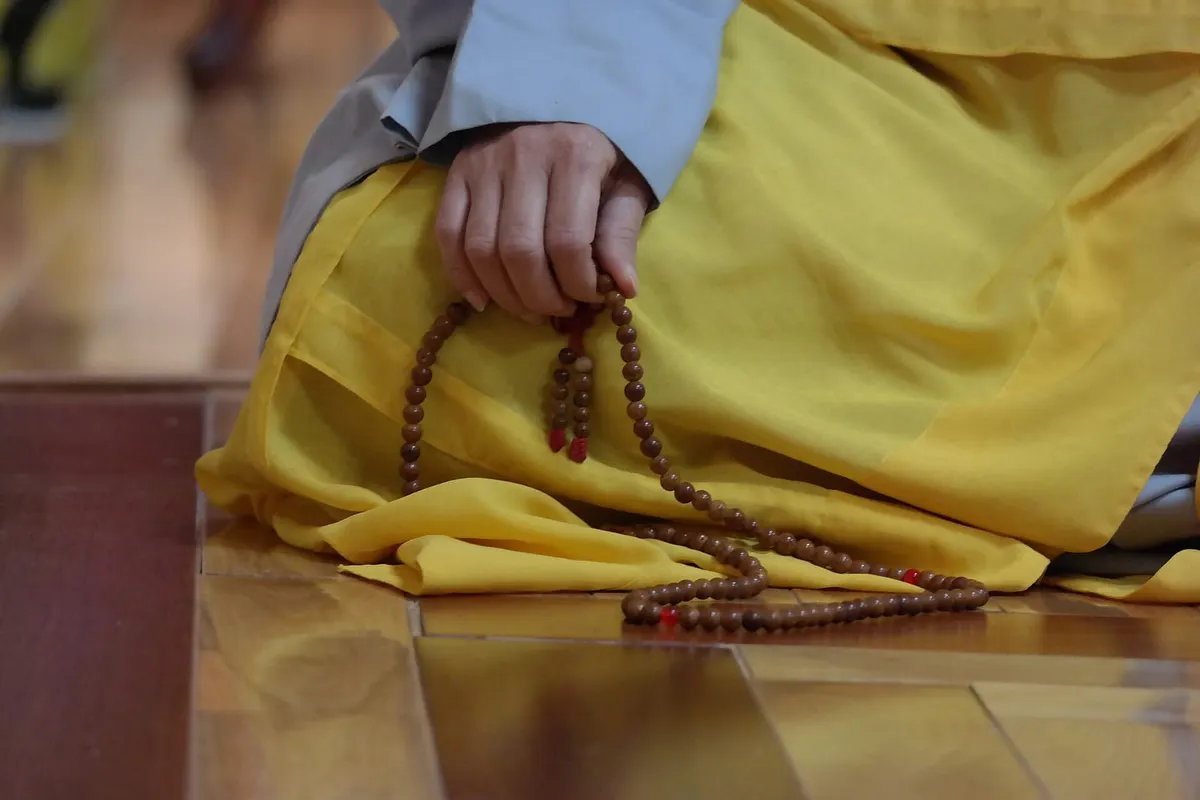
A traditional japa mala has 108 beads. Hold it in your right hand, draped over the middle finger. Use your thumb to advance one bead per repetition. The index finger should not touch the mala.
When you reach the Sumeru (the guru bead — the largest bead at the center), do not cross over it. Instead, flip the mala and continue in the reverse direction.
Why the index finger is not used
The instruction that the index finger should not touch the mala is not arbitrary, and it has both a traditional and a practical explanation.
The traditional reason. In the symbolism most commonly given, the index finger (tarjani) is the finger of pointing, accusation and ego. It is associated with rajas — restlessness and assertion — while the thumb and the middle and ring fingers are considered more suited to receptive, steady action. Keeping the index finger off the mala is a small physical reminder that the round is not an act of grasping.
The practical reason. Holding the mala over the middle finger and advancing beads with the thumb gives a stable, low-tension grip. If the index finger is used, it tends to pinch or flick the bead, which speeds the round up and turns the mala into a fidget. The thumb-and-middle-finger grip is slower and more deliberate, which is the point.
Where it varies. The prohibition is strongest in Vaishnava practice. Some Shaiva and Shakta lineages use the index finger, and some practitioners hold the mala differently altogether. If your family or teacher has a method, follow it; the principle behind the rule — attention over speed — matters more than the finger.
4. Using a Digital Counter
If you prefer a digital counter like our Naam Jaap Counter, tap once per repetition. The advantage is tracking your progress over days and weeks, setting targets, and maintaining streaks without worrying about bead counting.
5. Maintain Rhythm
Find a natural pace — not too fast (which leads to mechanical repetition) and not too slow (which allows the mind to wander). The sweet spot is where each repetition feels intentional but effortless.
Common Mistakes to Avoid
- Racing through the count — Quality matters more than quantity. One mindful round of 108 is worth more than ten distracted rounds.
- Irregular practice — Consistency beats intensity. Even 10 minutes daily is better than an hour once a week.
- Expecting instant results — Jaap is a gradual process. Benefits accumulate over weeks and months.
- Wrong pronunciation — Learn the correct pronunciation of your mantra from a teacher or reliable source. Mispronunciation can change the meaning entirely.
- Giving up too soon — The mind will resist. Restlessness in the first few weeks is normal. Push through gently.
How Many Repetitions?
Traditional recommendations:
- 108 repetitions (1 mala round) — standard daily minimum
- 1,008 repetitions — for deeper practice or special occasions
- 1 lakh (100,000) — for a purashcharana (intensive practice cycle)
For beginners, start with 1 round of 108 and gradually increase. Read our guide on 108 vs 1008 — Which Mala Count Is Right for You? for more details.
Benefits of Regular Naam Jaap
For the full traditional framing — and for what research does and does not support — see Naam Jaap Ke Fayde. In brief:
- Mental clarity — Regular chanting calms the chitta (mind-stuff) and reduces anxiety
- Improved concentration — The practice of returning to the mantra trains single-pointed focus
- Emotional balance — Devotion creates an inner refuge during life’s challenges
- Spiritual progress — Jaap purifies the antahkarana (inner instrument) and prepares it for deeper meditation
- Physical health — Practitioners commonly report better sleep and a calmer body. Research on meditation in general shows modest, mixed effects on stress and anxiety, and no study has isolated naam jaap as a treatment for any condition. Treat any physical benefit as a side effect of regular calm practice, not a medical outcome.
Building a Daily Practice
Start small and be consistent:
- Week 1–2: 1 round of 108, once daily
- Week 3–4: 1 round of 108, twice daily (morning and evening)
- Month 2: 2 rounds of 108, twice daily
- Month 3+: Increase gradually based on your comfort
Use our Naam Jaap Counter to track your daily practice, set goals, and maintain your streak.
In Closing
Naam Jaap is simple in technique but profound in effect. The great saints — Tulsidas, Mirabai, Chaitanya Mahaprabhu — all emphasized the power of the divine name as the easiest and most effective path to God in the Kali Yuga.
Begin today. Choose your mantra. Sit quietly. And let the name do its work.
Om Shanti.
Sources
- Bhagavad Gita 10.25 — japa named among the highest forms of worship.
- Bhagavata Purana — Nama Sankirtana in the Kali Yuga.
- Goyal M, Singh S, Sibinga EMS, et al. “Meditation Programs for Psychological Stress and Well-being: A Systematic Review and Meta-analysis.” JAMA Internal Medicine. 2014;174(3):357–368.
Start your digital sadhana today.
Track your mantra practice with our free Naam Jaap Counter.
Open Naam Jaap Counter →