Shani Dev — Saturday Worship, Mantras & the Meaning of Sade Sati
Who Shani Dev is in the Puranas, why he is feared and why that fear is misplaced, how to worship him at home on Saturday, his mantras with meanings, the Hanuman connection, and a calm explanation of Sade Sati and Dhaiya.
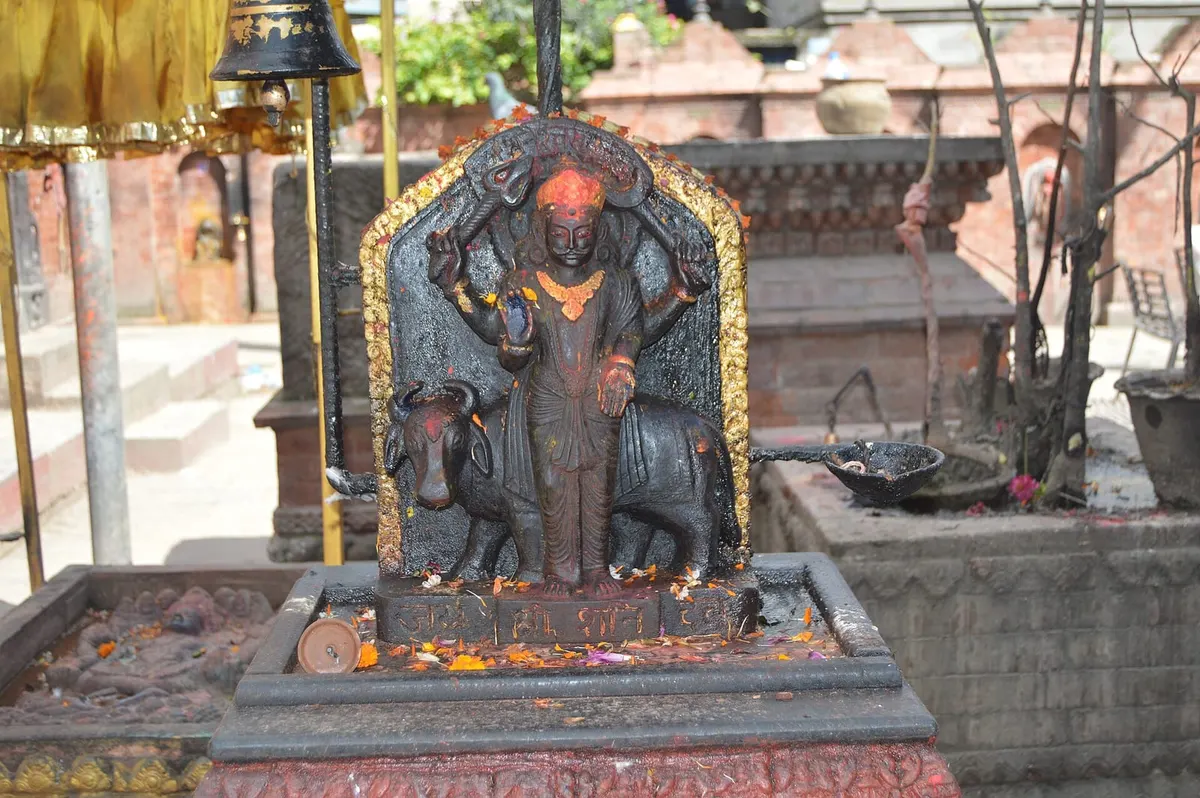
Few deities are approached with as much anxiety as Shani Dev. People visit his shrines when an astrologer has warned them, offer oil nervously, and leave quickly. This is a pity, because the Shani of the Puranas is not a tormentor. He is the deity who makes sure that effort is paid for and shortcuts are not. Saturday worship, understood properly, cultivates the patience, discipline and honest work that Shani rewards.
Who Shani Is
In the Puranas, Shani is the son of Surya, the sun god, and Chhaya, the “shadow” form that Surya’s wife Sanjna left behind when she could no longer bear his brilliance. This makes him the brother of Yama, lord of death and dharma: Yama judges after death, Shani administers justice during life.
His proper Sanskrit name is Shanaishchara — “the slow mover.” Saturn takes roughly twenty-nine and a half years to circle the zodiac, about two and a half years in each sign, and this slowness is the key to his character. He does not act suddenly. He accumulates, weighs, and returns.
His title is karma-phala-data — the giver of the fruits of action. Tradition holds that he delivers exactly what has been earned, neither more nor less. This is why he is called the most just of the Navagrahas, the nine planetary deities, and also why he is feared: a deity who delivers what is earned frightens only someone who suspects the ledger is against them.
Why the fear is misplaced
The same tradition that calls Shani stern also calls him the friend of the labourer, the servant, the elderly, the disabled and the poor — everyone who works without recognition. He is said to favour discipline, humility and truthfulness, and to be hard on arrogance, cruelty and dishonesty. A person who works honestly and treats others with dignity has, in the traditional understanding, little to fear from Shani and much to gain.
Iconography and Sacred Places
Shani is depicted as dark-complexioned, dressed in black or deep blue, seated on a crow, his vahana. He carries a sword, bow and arrows, or a trident, and his gaze is famously described as heavy. Iron is his metal, black sesame his grain, and the shami and peepal trees are associated with him.
Three shrines are especially well known.
- Shani Shingnapur (Ahmednagar district, Maharashtra) — an open-air shrine where Shani is worshipped as a tall black stone slab on a platform with no roof over it. The village is famous for houses traditionally built without doors, in the belief that Shani protects it from theft.
- Kokilavan Shani Dham (near Kosi Kalan, Mathura district, Uttar Pradesh) — tradition holds that Shani performed penance here to see Krishna, who appeared to him as a koel (kokila), giving the grove its name.
- Thirunallar Saneeswaran Temple (Karaikal, Puducherry) — one of the Navagraha temples of the Tamil country, linked to King Nala, who tradition says was freed of Shani’s affliction after bathing in the temple tank.
Saturday Worship at Home, Step by Step
Saturday (Shanivar) is Shani’s day. Unlike most deities, Shani is traditionally worshipped in the evening, around sunset. Many families prefer not to install a Shani murti in the home shrine; a picture, or a lamp under a peepal tree, is considered sufficient.
- Bathe and wear clean clothes. Dark blue or black is customary but not required.
- Set the place. Spread a black or dark blue cloth and place the image or a simple iron object on it.
- Light a sesame-oil lamp. A lamp of til (sesame) oil is the most characteristic Shani offering. Mustard oil is also used. For Shani, the tradition is oil rather than ghee.
- Offer black til, black urad, and blue or dark flowers. Blue aparajita or any dark flower is preferred. Tradition associates red flowers with Mangal (Mars), so they are generally set aside for this puja.
- Recite a mantra or stotra. The beej mantra 108 times, the Navagraha stotra verse, or the Shani Chalisa — see below.
- Make a small act of charity. Set aside something to give: oil, black til, a blanket, food for someone who needs it.
- Close with the Hanuman Chalisa. Many households end Saturday worship this way, for reasons explained below.
What not to do
- Do not approach Shani with bargaining or panic. Tradition holds that he is pleased by steadiness, not fear.
- Do not buy iron, oil or black items for your own use on Saturday; those are things one gives, not takes.
- Do not offer alcohol or meat, and do not perform the puja in anger or while intoxicated.
Shani Mantras with Meanings
| Mantra | Devanagari | Transliteration | Meaning |
|---|---|---|---|
| Beej mantra | ॐ शं शनैश्चराय नमः | Oṃ Śaṃ Śanaiścarāya Namaḥ | ”Om, Sham — salutations to Shanaishchara, the slow mover.” Sham is Shani’s seed syllable. |
| Shani Gayatri | ॐ शनैश्चराय विद्महे छायापुत्राय धीमहि तन्नो मन्दः प्रचोदयात् | Oṃ Śanaiścarāya Vidmahe Chāyāputrāya Dhīmahi Tanno Mandaḥ Pracodayāt | ”We know Shanaishchara; we meditate on the son of Chhaya. May Manda (the slow one) inspire us.” Other versions of this Gayatri exist. |
| Navagraha stotra verse | नीलाञ्जनसमाभासं रविपुत्रं यमाग्रजम् । छायामार्तण्डसम्भूतं तं नमामि शनैश्चरम् ॥ | Nīlāñjana-samābhāsaṃ Ravi-putraṃ Yamāgrajam, Chāyā-mārtaṇḍa-sambhūtaṃ taṃ namāmi Śanaiścaram | ”Him who shines like dark blue collyrium, the son of the Sun, brother of Yama, born of Chhaya and Martanda — to that Shanaishchara I bow.” |
| Tantric beej | ॐ प्रां प्रीं प्रौं सः शनैश्चराय नमः | Oṃ Prāṃ Prīṃ Prauṃ Saḥ Śanaiścarāya Namaḥ | The extended seed-syllable form used in Navagraha rituals; the syllables are not translated but invoked. |
The Navagraha stotra verse, attributed to Vyasa, is how Shani is most often invoked in temple worship. The beej mantra is the simplest for daily japa; our guide on how to do naam jaap correctly covers the method.
Two longer texts are also popular. The Shani Chalisa is a forty-verse Hindi hymn in the style of the Hanuman Chalisa, easily learned and recited on Saturdays. The Dasharatha Shani Stotra is a Sanskrit hymn tradition ascribes to King Dasharatha, Rama’s father, who is said to have prayed to Shani to avert a transit that would have brought famine; Shani, pleased with his courage, granted the request. Its opening verse is one of the clearest statements of who Shani is:
नमः कृष्णाय नीलाय शितिकण्ठनिभाय च । नमः कालाग्निरूपाय कृतान्ताय च वै नमः ॥
“Salutations to the dark one, the blue one, who resembles the blue-throated Shiva. Salutations to him whose form is the fire of time, and to him who brings things to their end.”
The stotra goes on to list Shani’s ten names — Kona, Pingala, Babhru, Krishna, Raudrantaka, Yama, Sauri, Shanaishchara, Manda and Pippalada — which are often recited on their own.
The Hanuman Connection
Ask any priest what to do on a Saturday and the answer will usually include Hanuman. There are two reasons.
The first is a story from later Ramayana traditions. Ravana, at the height of his power, had imprisoned the nine planetary deities in Lanka so that they could not influence his fortunes. When Hanuman reached Lanka in search of Sita, he freed them, and Shani is said to have promised that whoever worshipped Hanuman would be spared the harshest of his effects. A related folk tale has Shani trying to test Hanuman, being pinned beneath him, and asking for oil to ease his bruises — one explanation for the custom of offering oil.
The second reason is temperamental. Hanuman embodies exactly what Shani rewards: tireless service, humility, courage and freedom from ego. Reciting the Hanuman Chalisa on Saturday is not a trick to bypass Shani; it cultivates the qualities that make his transit bearable.
Sade Sati, Explained Calmly
Sade Sati literally means “seven and a half.” In Vedic astrology it is the period during which transiting Saturn passes through the sign before your natal Moon sign, the Moon sign itself, and the sign after. Since Saturn spends about two and a half years in each sign, the whole passage takes roughly seven and a half years, in three phases of about two and a half years each:
| Phase | Saturn’s position | Traditional description |
|---|---|---|
| First (rising) | 12th sign from natal Moon | Changes begin; expenses and mental restlessness |
| Second (peak) | On the natal Moon sign | The most demanding phase; tests of health, relationships, work |
| Third (setting) | 2nd sign from natal Moon | Consolidation; the lessons settle |
Since Saturn circles the zodiac every twenty-nine and a half years, most people experience Sade Sati two or three times in a lifetime.
Some things worth saying plainly. Sade Sati is an astrological transit, not a curse; roughly a quarter of all people are in it at any given time, most of them living ordinary lives. Traditional astrologers do not describe it as uniformly bad — its effect is said to depend on Saturn’s placement in the natal chart, and many call it a period of hard work that yields lasting results. No one can honestly promise what a transit will bring, and this article does not.
Dhaiya (“two and a half”) is Saturn’s transit through the fourth or eighth sign from the natal Moon, lasting about two and a half years. Tradition considers it demanding in a similar way, though shorter.
Remedies as Devotion, Not Magic
The traditional “remedies” (upaya) for Shani are best understood as a curriculum in the qualities he values, not as transactions. The thread running through all of them is service to those with less.
- Feed the poor and the hungry, especially on Saturdays. This is the remedy most often mentioned first.
- Donate black til, black urad, mustard oil, iron, black cloth, blankets, footwear or umbrellas — the last two traditionally before the monsoon, to those who work outdoors.
- Serve the elderly, labourers, and people with disabilities. Shani is regarded as their patron, and tradition holds that kindness to them is kindness to him.
- Work honestly and keep your commitments. Astrologers of every generation have said this is the real remedy, and it costs nothing.
- Recite the Hanuman Chalisa or the Shani beej mantra regularly — steadiness of practice is itself Saturnine.
Blue sapphire is sometimes recommended, but tradition treats it with caution and only on a qualified astrologer’s guidance; it is not a routine remedy.
Shani Jayanti and Shani Amavasya
Shani Jayanti, the birthday of Shani, falls on the new-moon day (Amavasya) of the month of Jyeshtha, usually in May or June. Temples hold oil abhisheka, and devotees fast, recite the stotras and give charity.
Shani Amavasya (Shanishchari Amavasya) is any new-moon day that falls on a Saturday. It occurs a few times a year and is regarded as especially suited to Shani worship, remembrance of ancestors, and charity.
Frequently Asked Questions
Can I worship Shani in the morning? You can, but evening is the traditional time. A short morning prayer is better than none.
Is it true that one should not look Shani in the eye? This is a custom at some temples, where devotees worship from the side. It is a tradition of reverence rather than a scriptural rule. Follow the practice of the temple you visit.
I am in Sade Sati. Should I be worried? Concern is natural, but fear is not useful. Treat the period as a call to steadiness: keep your commitments, avoid shortcuts, serve others, and maintain a regular practice.
Do I need to fast on Saturdays? Some devotees take a single meal or eat only after the evening puja. None of this is compulsory, and anyone with a health condition should not fast.
Which is more effective, the Shani mantra or the Hanuman Chalisa? Tradition recommends both, and most households do both on Saturday. Choose whichever you can sustain; sustained practice is what Shani is said to respect.
Closing Thought
Shani asks for nothing exotic. He asks that you work, keep your word, treat the people who serve you decently, and keep your composure when life is slow. A sesame-oil lamp on a Saturday evening is a small reminder of those things. Light it without fear.
Related reading
Start your digital sadhana today.
Track your mantra practice with our free Naam Jaap Counter.
Open Naam Jaap Counter →